


Choosing the Right Tech Stack in 2026: A Guide for Business Owners (Not Just Developers)
August 13, 2026
Non-technical business owners: Decode the tech stack decision for your new web app in 2026. This guide simplifies React, Vue, SQL, and microservices for smart choices.
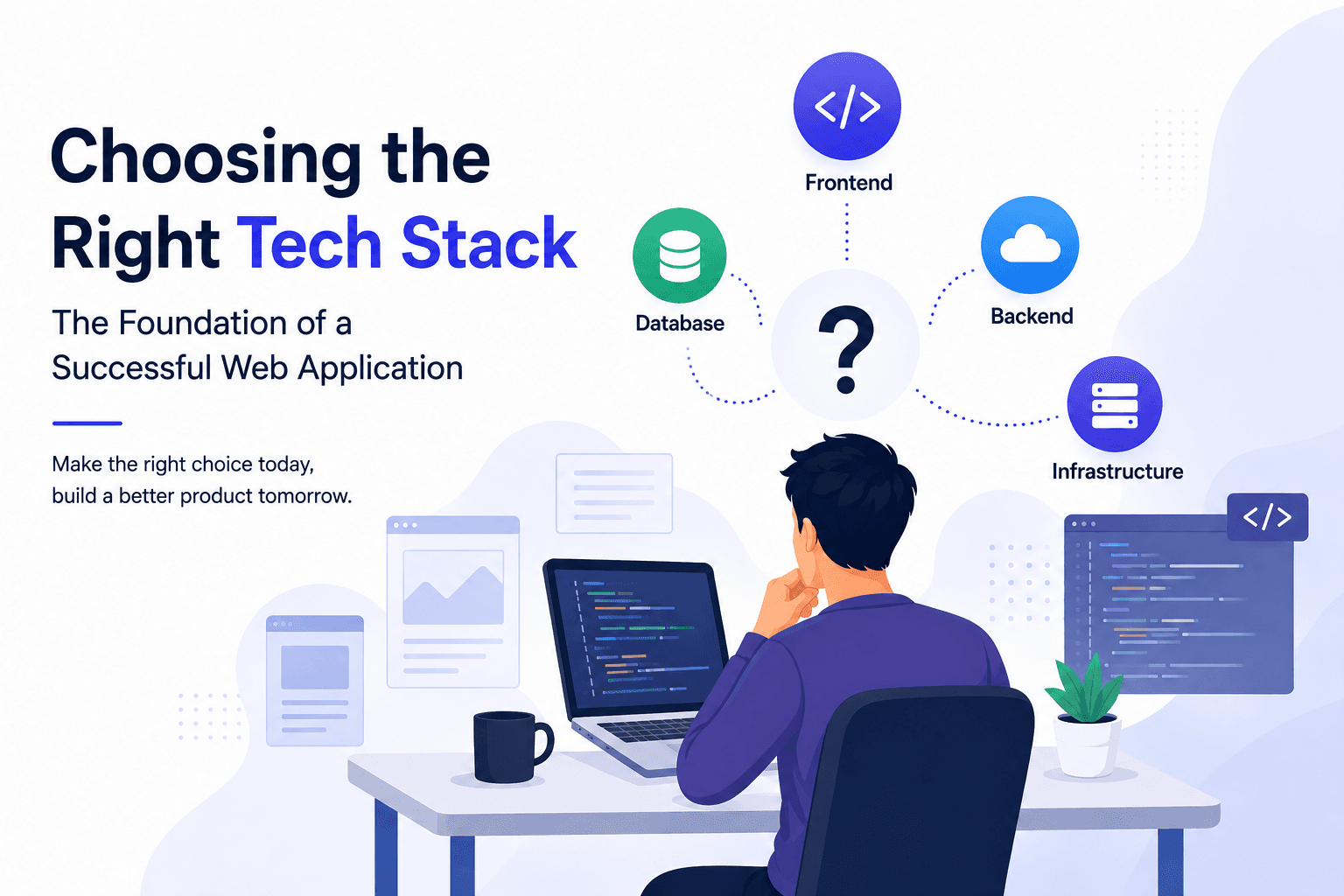
If you're building a new web application, one of the earliest decisions you'll face is also one of the most consequential: what technology stack should power it? For non-technical founders and business owners, this conversation can feel like it's happening in a foreign language — React vs. Vue, SQL vs. NoSQL, monolith vs. microservices.
Start With the Problem, Not the Technology
The most common mistake businesses make is picking a stack because it's popular, not because it fits the problem. A stack that's perfect for a high-traffic social app may be massive overkill for an internal inventory tool — and vice versa.
Before any technical conversation, get clear on:
- How many users will realistically use this in year one? In year three?
- Does the product need to scale quickly, or does it need to launch fast and iterate?
- Will this integrate with existing systems (payment processors, CRMs, internal databases)?
- Who will maintain this a year from now — an in-house team, an agency, or a mix?
The answers to these questions matter far more than which framework has the most GitHub stars this month.
The Core Building Blocks, Explained Simply
Frontend (what users see and interact with): Frameworks like Next.js or React handle this. The right choice depends on how interactive the interface needs to be and how important fast page loads are for SEO and user experience.
Backend (the logic that runs behind the scenes): Node.js/Express, NestJS, and Python-based frameworks like FastAPI are common choices. This layer handles business logic, authentication, and talking to your database.
Database: Relational databases like PostgreSQL are the default for most business applications because they keep data structured and consistent — critical for anything involving transactions, user accounts, or reporting.
Hosting and Infrastructure: Where your application actually runs — a VPS, a cloud provider like AWS, or a managed platform. This affects cost, reliability, and how easily the system scales as your business grows.
Why "Future-Proof" Is the Wrong Goal
Many businesses ask for a stack that's "future-proof" — one that will never need to change. That's the wrong target. Technology evolves, and any stack will eventually need updates or partial rewrites. The better goal is a stack that's:
- Well-supported, with an active community and long-term maintenance
- Boring where it counts — proven, stable technology for the core of the system, saving experimentation for features where it's low-risk
- Modular, so individual pieces can be upgraded or replaced without rebuilding the whole application
Common Pitfalls to Avoid
- Over-engineering early. Building for a million users on day one, when you have zero, adds cost and complexity without adding value.
- Under-engineering for growth. The opposite problem — choosing the cheapest, fastest option with no plan for what happens if the product succeeds.
- Ignoring the maintenance question. A stack is only as good as the team that can support it. Exotic or niche technology choices can leave you stuck if your original developers move on.
- Letting trends drive decisions. The newest framework isn't automatically the right one for a business-critical application.
The Real Question to Ask Your Dev Partner
Instead of asking "what's the best tech stack?" — a question with no single right answer — ask your development partner: "Why is this stack right for what we're trying to build, and what happens when we need to scale or change direction?"
A good answer will be grounded in your specific goals, budget, and timeline — not in what's fashionable this year.