

Cybersecurity and AI: How AI Is Changing the Way We Protect Digital Systems
August 14, 2026
- Cybersecurity
- Artificial Intelligence
- AI Security
- Cyber Security
- AI Cybersecurity
- Cyber Attack Prevention
Cybersecurity threats are becoming more sophisticated as businesses move their applications, data, and operations online. At the same time, Artificial Intelligence (AI) is changing how organizations detect threats, protect sensitive information, and respond to security incidents.
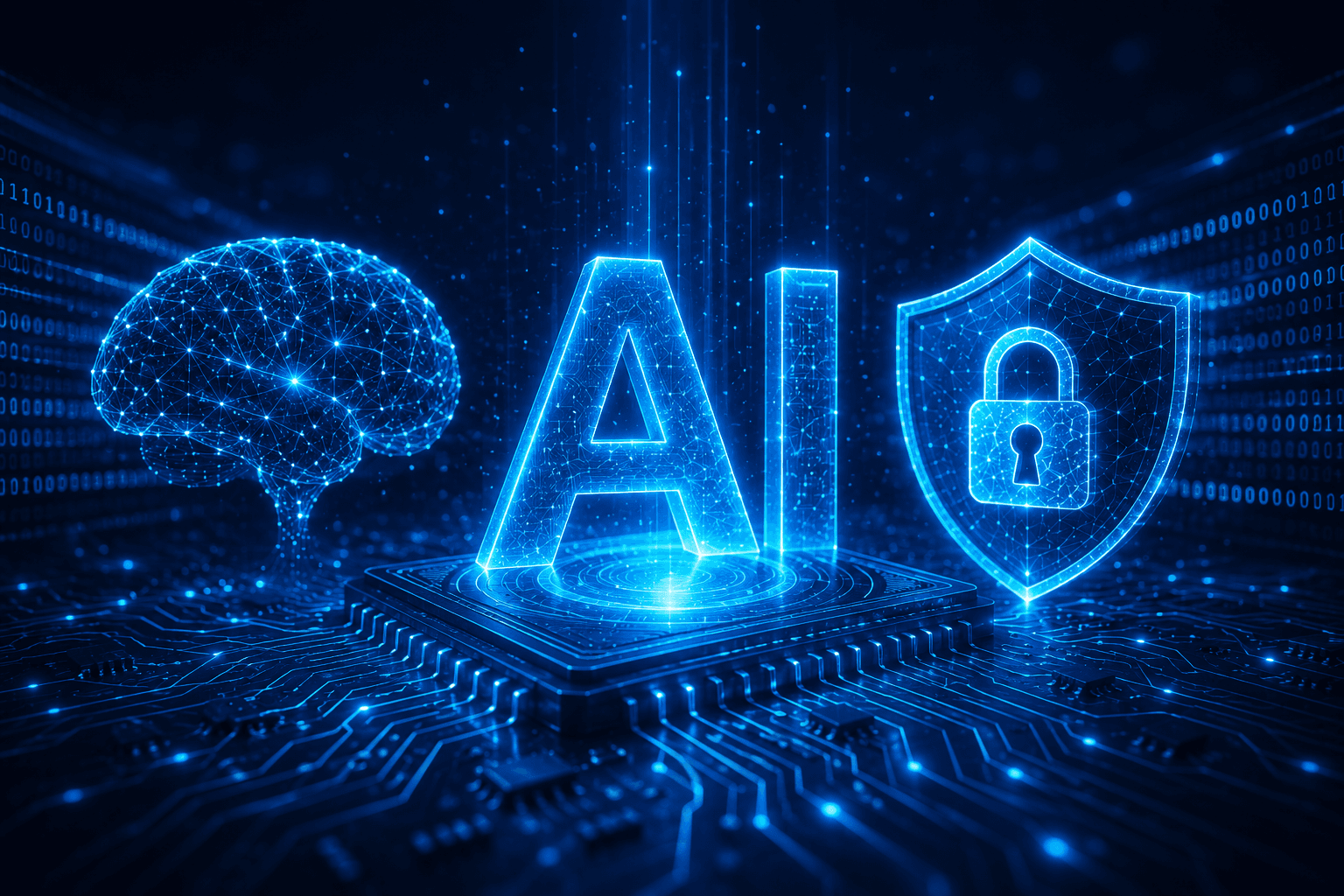
AI can analyze huge volumes of data, identify unusual behavior, automate security operations, and help security teams respond faster. However, attackers are also using AI to create more sophisticated attacks.
This creates an important question:
How can businesses use AI to improve cybersecurity without creating new security risks?
The answer is to combine AI with strong security architecture, access controls, monitoring, human oversight, and secure development practices.
The Growing Connection Between AI and Cybersecurity
Traditional cybersecurity systems often depend on predefined rules and signatures. While these methods remain important, modern attacks can change rapidly and may not match previously known patterns.
AI-based security systems can analyze patterns and identify unusual activity.
For example, AI can help detect:
- Unusual login behavior
- Suspicious network traffic
- Abnormal API requests
- Malware patterns
- Account takeover attempts
- Phishing activity
- Data access anomalies
- Potential insider threats
- Automated attacks against applications
AI therefore becomes another layer of defense rather than a replacement for fundamental cybersecurity practices.
How AI Can Help Solve Cybersecurity Problems
1. Threat Detection
AI can continuously analyze application, network, and system activity to identify suspicious patterns.
Instead of waiting for a security administrator to manually investigate every event, an AI-assisted system can prioritize potentially dangerous activities for investigation.
2. Real-Time Anomaly Detection
Suppose a user normally logs into an application from Mumbai during business hours.
Suddenly, the same account attempts multiple logins from different locations and accesses thousands of records.
An AI-powered security system can identify this behavior as abnormal and trigger additional verification or temporarily restrict access.
3. Automated Incident Response
AI can help security teams respond to incidents faster.
Depending on the organization's security architecture, automated workflows can:
- Detect suspicious activity.
- Assign a risk score.
- Alert the security team.
- Restrict a compromised account.
- Block suspicious traffic.
- Record the incident.
- Generate an investigation report.
Human approval should remain important for high-impact actions.
4. Phishing and Social Engineering Detection
AI can analyze emails, messages, domains, URLs, and communication patterns to identify potential phishing attempts.
This can help organizations detect suspicious messages before employees interact with malicious links or attachments.
5. Vulnerability Management
AI can assist development and security teams by analyzing source code, dependencies, configurations, and security findings.
However, AI-generated recommendations should always be validated. Developers should not blindly apply AI-generated security fixes.
OWASP's 2025 Top 10 for web applications continues to emphasize risks such as broken access control, security misconfiguration, supply-chain failures, cryptographic failures, injection, and authentication failures.
AI Creates New Cybersecurity Risks
AI is not only a defensive technology. Attackers can also use AI to increase the speed and scale of attacks.
For organizations building AI-powered applications, this creates a new security layer that needs to be considered.
OWASP's 2025 guidance for LLM applications identifies risks including prompt injection, sensitive information disclosure, supply-chain vulnerabilities, data and model poisoning, improper output handling, excessive agency, system prompt leakage, vector and embedding weaknesses, misinformation, and unbounded consumption.
Common AI Security Problems
Prompt Injection
An attacker can provide specially crafted instructions that attempt to manipulate an AI application's behavior.
Solution:
- Treat user input as untrusted.
- Separate system instructions from user-controlled content.
- Apply input validation.
- Restrict tools available to the model.
- Add authorization checks outside the model.
- Monitor suspicious prompts.
Sensitive Information Disclosure
AI applications may accidentally expose confidential information if data access and output controls are poorly designed.
Solution:
- Never provide unrestricted database access to an AI model.
- Apply role-based access control.
- Mask sensitive information.
- Maintain strict data boundaries.
- Log access to sensitive resources.
Excessive AI Agency
An AI agent with permission to send emails, modify databases, execute transactions, or call external APIs can create serious risks if its actions are not controlled.
Solution:
Use the principle of least privilege.
Give an AI agent only the permissions it actually needs.
For high-risk actions, require human approval.
Insecure AI-Generated Code
Developers increasingly use AI to generate application code. However, generated code can contain security weaknesses or rely on inappropriate libraries.
AI-generated code should therefore go through normal code review, dependency scanning, testing, and security validation. OWASP specifically highlights secure coding and validation as important mitigations for AI-related risks.
A Practical AI + Cybersecurity Strategy
Businesses can build a stronger security architecture by combining several layers.
Layer 1: Secure Application Development
Implement:
- Secure coding standards
- Code reviews
- Dependency scanning
- SAST
- DAST
- API security testing
- Regular penetration testing
Layer 2: Identity and Access Management
Use:
- Multi-factor authentication
- Role-based access control
- Strong password policies
- Short-lived access tokens
- Least-privilege permissions
- Session monitoring
Layer 3: Infrastructure Security
Protect infrastructure using:
- Firewalls
- WAF
- Network segmentation
- Secure cloud configurations
- Encryption
- Regular backups
- Patch management
Layer 4: AI Security
For AI-powered applications:
- Validate prompts and inputs.
- Restrict model permissions.
- Secure RAG data sources.
- Protect vector databases.
- Validate model outputs.
- Monitor AI actions.
- Implement rate limits.
- Protect API keys and secrets.
- Maintain audit logs.
Layer 5: Monitoring and Response
Security does not end after deployment.
Organizations should continuously monitor:
Users → Applications → APIs → Infrastructure → AI Models → Data
Security alerts should be prioritized based on risk and investigated by the appropriate team.
AI Should Assist Security Teams, Not Replace Them
One of the biggest mistakes organizations can make is treating AI as a completely autonomous security solution.
AI can identify patterns and accelerate investigations, but important decisions should have appropriate human oversight.
This is especially important when AI can access sensitive data or perform actions on behalf of users.
OWASP's guidance also highlights excessive agency and the need to control the permissions and actions available to AI systems.
The Future of AI-Powered Cybersecurity
The future of cybersecurity will increasingly combine automation, machine learning, generative AI, and human expertise.
Security teams will be able to use AI to:
- Analyze security events
- Investigate suspicious behavior
- Summarize incidents
- Detect anomalies
- Assist vulnerability management
- Generate security reports
- Prioritize risks
- Support security operations teams
At the same time, organizations will need dedicated AI security practices as AI agents become more capable and autonomous. OWASP released separate guidance for Agentic AI security in 2025 because autonomous AI systems introduce additional security challenges.
Conclusion
AI is becoming an important component of modern cybersecurity, but it is not a magic solution.
The strongest approach is to combine AI-powered detection and automation with secure application development, strong identity management, least-privilege access, encryption, monitoring, testing, and human oversight.
Businesses adopting AI should think about security from the beginning—not after the application has already been deployed.
Secure AI is not just about protecting the AI model. It is about protecting the entire system around it.
Key Takeaway
Use AI to make cybersecurity faster and smarter, but build security controls around AI so that AI itself does not become the next security vulnerability.
References: OWASP Top 10:2025 and OWASP GenAI Security Project guidance.